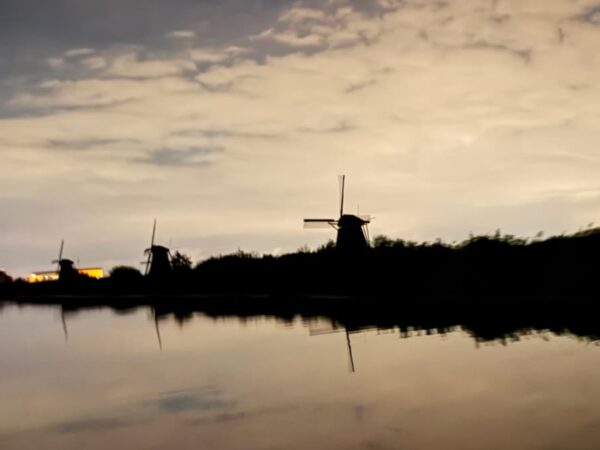
Walking below sea level in Kinderdijk
Pull your wellies right up to your armpits: we’re heading to Kinderdijk! Actually… you can leave them at home. Surprisingly enough, you won’t need them here. And that’s something of a small miracle. Without centuries of water management, you could find yourself standing neck-deep in water. Kinderdijk helps make sure this part of the Netherlands remains land.
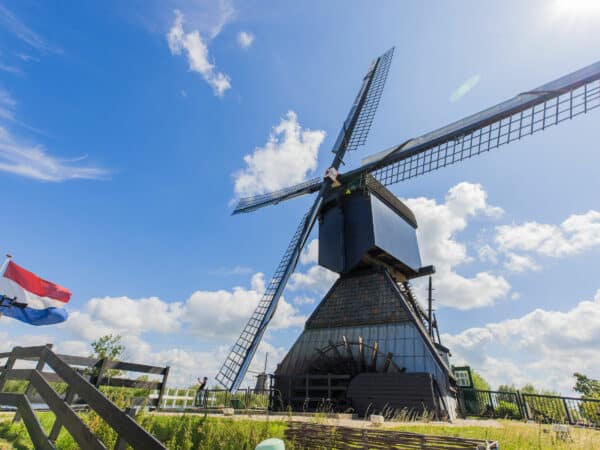
“If you look purely at the level of the landscape, the water here would be about a metre and a half above ground without our dikes and pumping stations,” explains Peter-Jan van Steenbergen, Managing Director of the Kinderdijk World Heritage Foundation. “Head further into the polder, to our Blokker windmill, for example, and the ground is even lower. You’re effectively standing at the bottom of a giant bathtub.”
Where river water meets the sea
Kinderdijk’s role in keeping the surrounding land dry is no coincidence. Its location is key: the low river level here makes it a natural place to discharge water from the polders. For 750 years, excess water has flowed towards Kinderdijk to be released into the river. A polder is an area of land enclosed by dikes, where the water level is carefully controlled. And here, at the bottom of our “bathtub”, there’s another challenge: fresh river water flowing down from the Alps meets salt water pushing inland from the sea. Sometimes, that creates extraordinary situations.
“Last summer, we experienced something that had never happened before in Kinderdijk’s history,” says Peter-Jan. “Extreme drought allowed seawater to push so far inland that the river water became too salty. We had to stop letting water into the polder to prevent the salt from entering the soil. If the water becomes too salty, our crops and familiar polder flowers disappear. In their place, you get a very different landscape, with plants and animals that thrive in salty conditions. It shows just how delicate the balance between fresh and salt water really is.”

What if we stopped pumping for 3 weeks?
If we did nothing for three weeks, the first cellars and roads would already start to flood. Stop for three months? Much of the country would face a serious problem. Without the pumps that drain the polders, Noord- and Zuid-Holland would turn into a vast inland sea. Large parts of Amsterdam and Rotterdam would be underwater, and the Dutch coastline would suddenly shift inland towards Utrecht and Eindhoven. Keeping the Netherlands dry takes constant work, even when everything around you looks perfectly calm.
From historic windmills to powerful pumping stations
To keep everyone from having to paddle their way around, Dutch water management has grown in scale over the centuries. As the soft peat soil gradually sank, millers had to arrange windmills in stages, lifting the water a little higher at each step. That process of land subsidence continues today.
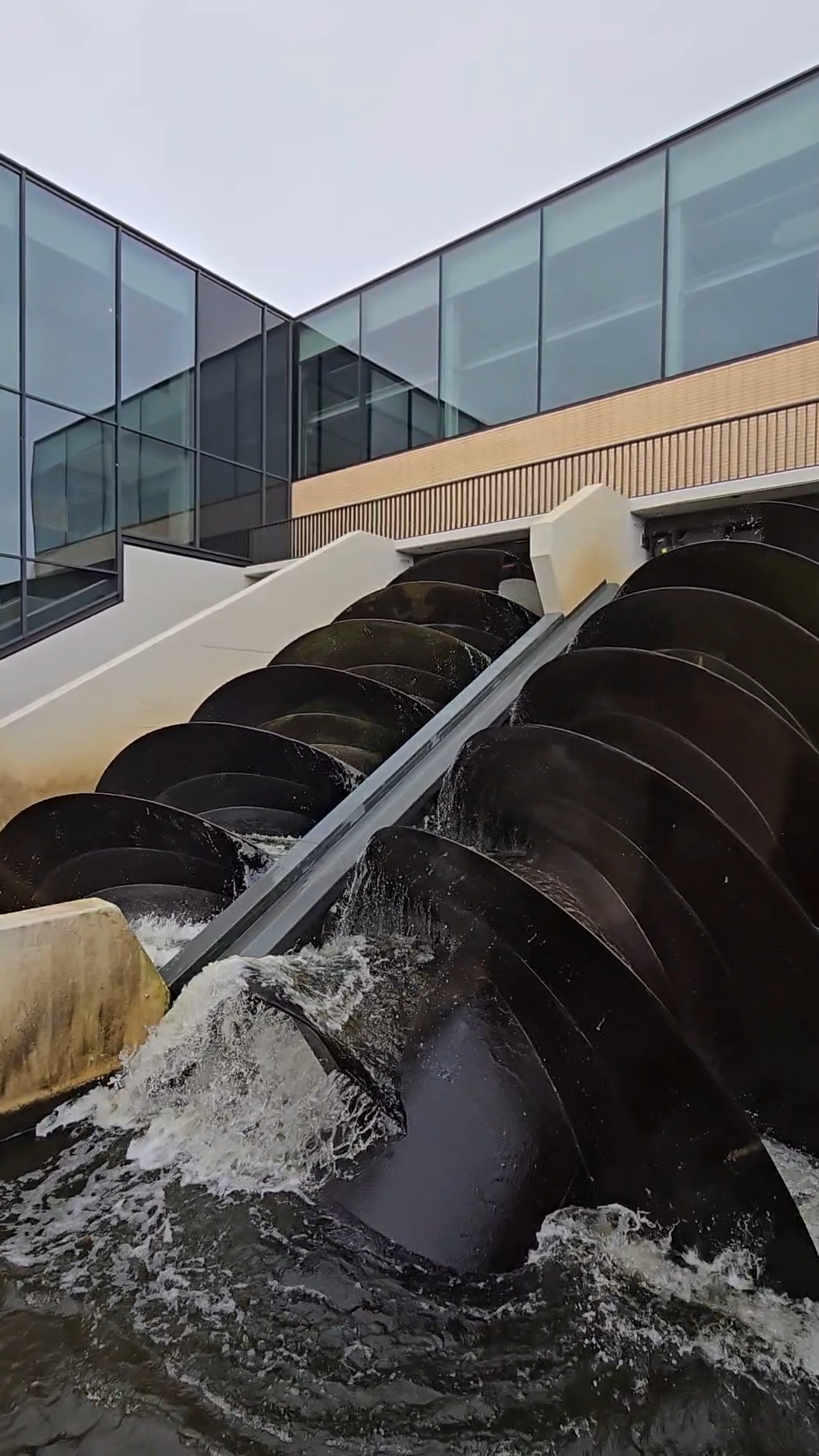
Yet those early windmills were only the beginning. While a traditional polder windmill could move around 50 cubic metres of water per minute, today’s J.U. Smit pumping station can move an impressive 500,000 litres in a single minute. To put that into perspective, that’s roughly the same amount of water you’d use showering non-stop for 43 days, pumped away in just one minute!
And the work continues. A major new project, De Nieuwe Waarden, is being developed to help keep the region dry in the future. From 2030, a new large pumping station in nearby Hardinxveld is planned to help handle the enormous volume of water.
A landscape shaped by Dutch ingenuity
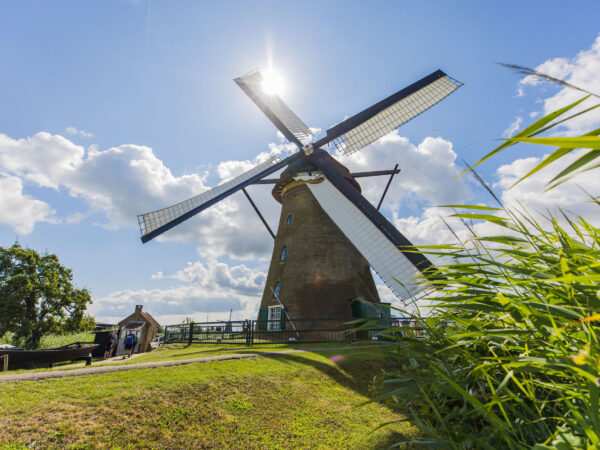
As you explore Kinderdijk, take a moment to think about where you’re standing. Water would naturally dominate this landscape. Yet centuries of Dutch knowledge, cooperation and ingenuity have made it possible to live here and walk around with dry feet. That’s something worth celebrating. The nineteen iconic Kinderdijk windmills are living proof of that expertise, and they still have a role to play.
“Our windmills still work,” Peter-Jan emphasises. “In an emergency, they’re our ultimate backup. We saw that during the Second World War: when fuel for the engines ran out, these windmills kept the polder dry using wind power alone. And did you know that in a force 5 wind, the Blokweer museum windmill can actually pump water faster than the electric pumping station right beside it? If the power ever fails, we can turn to the same knowledge that has protected us for centuries.”

Come and see how we’ve been keeping the water at bay for centuries!
Written by